Piracy Update

Missed the golden age by three or four-odd centuries? Don't worry: you can still get into the business.
BBC NEWS
Life in Somalia's pirate townBy Mary Harper
BBC Africa analyst
Whenever word comes out that pirates have taken yet another ship in the Somali region of Puntland, extraordinary things start to happen.
There is a great rush to the port of Eyl, where most of the hijacked vessels are kept by the well-armed pirate gangs.
People put on ties and smart clothes. They arrive in land cruisers with their laptops, one saying he is the pirates' accountant, another that he is their chief negotiator.
With yet more foreign vessels seized off the coast of Somalia this week, it could be said that hijackings in the region have become epidemic.
Insurance premiums for ships sailing through the busy Gulf of Aden have increased tenfold over the past year because of the pirates, most of whom come from the semi-autonomous region of Puntland.
In Eyl, there is a lot of money to be made, and everybody is anxious for a cut.
Entire industryThe going rate for ransom payments is between $300,000 and $1.5m (£168,000-£838,000).
A recent visitor to the town explained how, even though the number of pirates who actually take part in a hijacking is relatively small, the whole modern industry of piracy involves many more people.
"The number of people who make the first attack is small, normally from seven to 10," he said.
"They go out in powerful speedboats armed with heavy weapons. But once they seize the ship, about 50 pirates stay on board the vessel. And about 50 more wait on shore in case anything goes wrong."
Given all the other people involved in the piracy industry, including those who feed the hostages, it has become a mainstay of the Puntland economy.
Eyl has become a town tailor-made for pirates - and their hostages.
Special restaurants have even been set up to prepare food for the crews of the hijacked ships.
As the pirates want ransom payments, they try to look after their hostages.
When commandos from France freed two French sailors seized by pirates off the Somali coast this week, President Nicolas Sarkozy said he had given the go-ahead for the operation when it was clear the pirates were headed for Eyl - it would have been too dangerous to try to free them from there.
The town is a safe-haven where very little is done to stop the pirates - leading to the suggestion that some, at least, in the Puntland administration and beyond have links with them.
Many of them come from the same clan - the Majarteen clan of the president of Somalia's transitional federal government, Abdullahi Yusuf.
Money to spendThe coastal region of Puntland is booming.
Fancy houses are being built, expensive cars are being bought - all of this in a country that has not had a functioning central government for nearly 20 years.
Observers say pirates made about $30m from ransom payments last year - far more than the annual budget of Puntland, which is about $20m.
When the president of Puntland, Adde Musa, was asked about the reported wealth of pirates and their associates, he said: "It's more than true".
Now that they are making so much money, these 21st Century pirates can afford increasingly sophisticated weapons and speedboats.
This means that unless more is done to stop them, they will continue to plunder the busy shipping lanes through the Gulf of Aden.
They even target ships carrying aid to feed their compatriots - up to a third of the population.
Warships from France, Canada and Malaysia, among others, now patrol the Somali coast to try and fend off pirate attacks.
An official at the International Maritime Organisation explained how the well-armed pirates are becoming increasingly bold.
More than 30% of the world's oil is transported through the Gulf of Aden, and even though the pirates lack the means to hijack huge tankers, there are reports that they have fired at them.
"It is only a matter of time before something horrible happens," said the official.
"If the pirates strike a hole in the tanker, and there's an oil spill, there could be a huge environmental disaster".
It is likely that piracy will continue to be a problem off the coast of Somalia as long as the violence and chaos continues on land.
Conflict can be very good for certain types of business, and piracy is certainly one of them.
Weapons are easy to obtain and there is no functioning authority to stop them, either on land or at sea.
Story from BBC NEWS:http://news.bbc.co.uk/go/pr/fr/-/2/hi/africa/7623329.stmPublished: 2008/09/18 15:10:52 GMT
© BBC MMVIII
Labels: the life aquatic
Cephalopod Update

Just when you thought it was safe to go back in the water: it's the Cephalopod Update!
I wasn't instantly impressed when
Kiarash started in about the fearsome Humboldt squid the other night, since it shares a name with the stoniest known county/university. (Stoned squid...wouldn't that make the be-all and end-all of Youtube videos...) But it turns out these things are pretty exciting. Quoth
National Geographic,
"Known as aggressive predators, Humboldt squid have powerful arms and tentacles, excellent underwater vision and a razor-sharp beak that easily tears through the flesh of their prey. They can also rapidly change their skin color in what appears to be a complex communication system."
Their diet consists of the usual fish, but they also love to snack on fishermen - and each other. In turn, the squid are preyed upon by whales. Well, I think I know what my next tattoo will be.
They may lack the quiet grace of little guys like the nautilus and my personal favorite, the striped pajama squid (which is really just a fancy cuttlefish if you do your research), but for their sheer shock and awe factor, these guys are the quarterbacks of cephalopods. I'm sorry, I can't in good conscience use a football analogy. I don't know the first thing about football. Let's say they're the tenors, not quarterbacks: abundant, yet impressive, but not quite as high on the "how-is-that-even-possible" scale as the
colossal squid, the coloratura of the cephalopods.
For instance:
"The squid are believed to live at depths of 660 to 2,300 feet (200 to 700 meters). They may be elusive in some parts, but they're not rare. [Stanford biologist William] Gilly estimates that 10 million squid may be living in a 25-square-mile (65-square-kilometer) area outside Santa Rosalia, Mexico." (
National Geographic again)
You might be wondering, "that's nice, but how does it affect
my life?" And that's the fun part. They're staging a
massive invasion off the coast in Ventura County. So I have to to urge those of you in Southern California: hang around the docks. Befriend a fisherman and sweet-talk him into taking you out on his boat so you can see this for yourself. Do this for me.
Labels: cephalopod update, science, the life aquatic
Oh right, I have a blog.
Things have been going on and said things have been pretty exciting, but it looks like I am going to continue forgetting I have a blog, and do so for long periods filled with Tuesday night rock shows and internal monologues conducted entirely in my native tongue,
yelling. Therefore, my blog remains empty. A digital breeze sweeps a pixelated tumbleweed across the screen as you refresh the page and give up to go read "Cat and Girl."
Oh screw it, as the kids say, it's a bird, it's a plane, IT'S THE CEPHALOPOD UPDATE!
Remember that colossal squid I mentioned a while back? They are going to microwave it.
THEY ARE GOING TO M*********ING MICROWAVE IT.
I'm not making this up:
Microwave plan for colossal squid
An industrial-scale microwave oven may have to be used to defrost a colossal squid caught in the Antarctic last month, scientists say.
They are pondering how to thaw out the half-tonne squid in a way that makes sure none of it rots before other parts have defrosted.
The squid has been kept frozen since it was caught by New Zealand fisherman in deep Antarctic waters in February.
Scientists want to preserve the unique specimen for detailed study.
Squid expert Steve O'Shea said the Mesonychoteuthis hamiltoni measured 10 metres (33ft) in length.
It weighed 495kgs (1,089lbs), heavier than an initial estimate of 450kgs (990lbs).
Mr O'Shea said it would take days for the colossal squid to defrost at room temperature - meaning its outer flesh could have rotted by the time the centre thawed.
He said a massive microwave was one option.
"There are certain microwave equivalents that are used by industry, for treating timber and the like, that we could probably fit this thing into," Mr O'Shea, of Auckland University of Technology, said.
Museum display
The fishermen were fishing for Patagonian toothfish in deep Antarctic waters when the squid - which was eating a toothfish - was caught in mid-February.
It took them two hours to reel in the huge creature.
The squid was frozen in the ship's hull and brought back to New Zealand for examination.
Scientists believe it is by far the largest specimen of the colossal squid ever caught.
At the time of its arrival, Mr O'Shea said calamari rings made from it would be like tractor tyres - although would taste of ammonia.
The squid is currently being kept at New Zealand's national museum, Te Papa Tongarewa, in Wellington.
Museum officials hope to embalm the squid and put it on display, while giving scientists access to study it.
Story from BBC NEWS:
http://news.bbc.co.uk/go/pr/fr/-/2/hi/asia-pacific/6478801.stm
Published: 2007/03/22 10:42:10 GMT
© BBC MMVIILabels: cephalopod update, the life aquatic
Snow Day
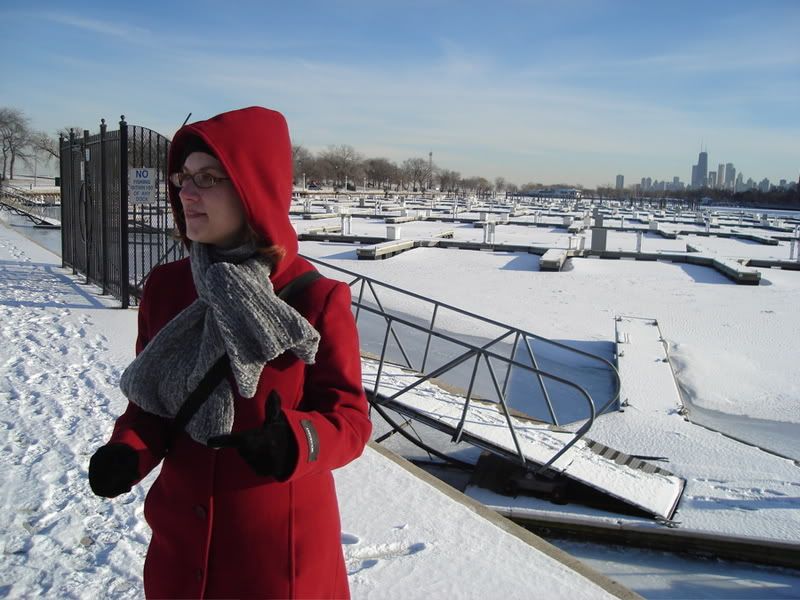
Hey ho, it's February! The windchill's wavering between five above and fifteen below zero, I've gone through a cauldron's worth of stew, and I'm actually doing needlepoint in the evenings. Am I beat by this weather?
Oh hell no.
Yesterday I convinced someone to hang out at the lake with me so I could finally sate my curiousity to see what exactly happens to a large body of water in this weather. There's a yacht club somewhat inland that had frozen almost entirely over. We wandered around the abandoned zoo and found some surprisingly content camels in the snow, and saw real icebergs in the polar bear's cove (sadly, he didn't jump on them, but went inside instead. I am now officially tougher than a polar bear). I even made friends with a monkey.
A grand day out.
Photos are posted
here.
Labels: the life aquatic
"World's tallest man saves dolphin"
Enough about me. Here's one from the BBC News
 The world's tallest man has saved two dolphins by using his long arms to reach into their stomachs and pull out dangerous plastic shards.
Mongolian herdsman Bao Xishun was called in after the dolphins swallowed plastic used around their pool at an aquarium in Fushun, north-east China. Attempts to use instruments failed as the dolphins contracted their stomachs. Guinness World Records list Mr Bao, 54, as the world's tallest living man at 2.36m (7ft 8.95in).
Recovering
Veterinarians turned to Mr Bao after attempts to extract the plastic shards at the aquarium in Fushun, Liaoning Province, had failed. The mammals had lost their appetite and were suffering depression, aquarium officials said. The heads of the dolphins were held back and towels wrapped around their teeth so Mr Bao could not be bitten. He then extended his 1.06m-long arm into the mammals' stomachs.
Chen Lujun, manager of Royal Jidi Ocean World, said Mr Bao was successful and the dolphins were "in very good condition now".
Local doctor Zhu Xiaoling told the state media agency Xinhua: "Some very small plastic pieces are still left in the dolphins' stomachs. "However the dolphins will be able to digest these and are expected to recover soon."
Mr Bao was confirmed as the world's tallest living man by Guinness World Records last year. He overtook the previous holder, Radhouane Charbib of Tunisia, by just 2mm. Guinness World Records say Mr Bao was of normal height until 16 but then put on a spurt that doctors were unable to explain, reaching his full height in seven years.Story from BBC NEWS:
http://news.bbc.co.uk/go/pr/fr/-/2/hi/asia-pacific/6178659.stm
Published: 2006/12/14 10:09:51 GMT
© BBC MMVI
Labels: the life aquatic


